CINEMATIC COMMONS
JAHNAVI TRIVEDI
MARCH I
FILMIC SPACEBOARD
DAYS OF BEING WILD// WONG KAR-WAI// 1990

The movie is set in Hong Kong and the Philippines in 1960–61. Yuddy, is a playboy in Hong Kong. His first lover in the film is Li-zhen, who suffers depression as a result of Yuddy's attitude. Li-zhen eventually seeks much-needed solace from a sympathetic policeman named Tide. Their near-romance is hinted but never materialises. His next romance is with a cabaret dancer whose stage name is Mimi whom he mistreats and she begins a period of self-destruction. Yuddy is conflicted about his feelings about his adoptive mother, a former prostitute, and is obsessed about finding his biological mother, whom he eventually discovers is a Filipino aristocrat. The film sets an initial base and is loosely connected, to Wong Kar-wai other films that includes; In the Mood for Love and 2046.


IN THE MOOD FOR LOVE// WONG KAR-WAI// 2000

Wong Kar-Wai's melancholy tale of love and loneliness.
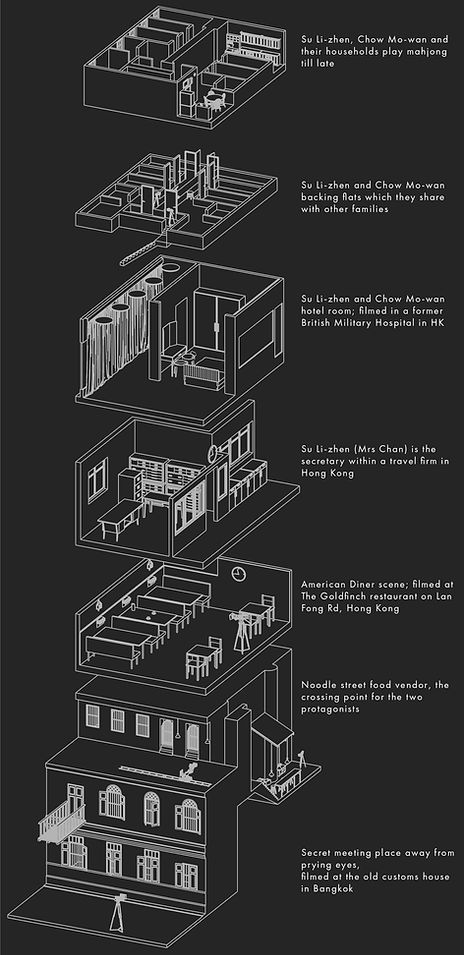
A moving, cleverly-told film, which uses the whole lexicon of cinema effectively. The camera lurks in doorways, down passageways, through windows, almost spying on Chow and Su Li-zhen as they seek solace with each other amid the paradoxical loneliness of a crowded city. Wong chose to transform an old hospital for British soldiers that was left vacant, into the hotel room. Mr. Chow and Mrs. Chang may or may not have given sensual expression to their affair in “room 2046”. Number 2046 is the room Mr. Chow rents to write and wait for Mrs. Chang, to avoid the prying gaze of neighbors. In the Mood for Love, its hotel room and frustrated love affair, become the origin for 2046’s obsessive longing. “2046” is thus the symbolic companion to the physical thresholds, like the doorway Mr. Chang exits from In the Mood for Love.

COCKROACH// AI WEIWEI// 2020

Cockroach is a poignant and dramatic visual record of the final moments of an independent, democratic Hong Kong.

Ai Weiwei’s “Cockroach” is a documentary film about the protests in Hong Kong in 2019. The Hong Kong government proposed a bill, which would have allowed extradition of criminal suspects from Hong Kong to face trial in mainland China. Filmed during the height of the protests, the documentary captures the extraordinary intensity of an unprecedented era in Hong Kong’s history. The controversial bill sparked immediate outrage over widespread fear of arbitrary detention and politically motivated trials that would decimate Hong Kong’s autonomy under ‘one country, two systems.’ Anti-bill protests escalated into pro-democracy demonstrations. Spanning the evolution of the protest movement, the film captures street demonstrations, police suppression and violence, and key events, such as the multi-day siege of Hong Kong Polytechnic University. Clashes between police and activists became increasingly violent, with police firing live bullets and protesters attacking officers and throwing petrol bombs. Graffiti remained a peaceful but persistent form of resistance in a city renowned for order. Tags and scrawls provide a crash course in the slogans, memes and demands of the protest movement, which remained determined to get its message across. “If the police tear down posters, graffiti is the only option left,” says the protestors.

FILMIC essay
The film; Cockroach talks about two most important motives of the protesters; Calling out for the complete withdrawal of the extradition bill and Expressing dissatisfaction with the police brutality and the way they handled the protests. The student unions and societies have been deeply involved. This essay is the compilation of snippets from the film showing concerns of the citizens.

Forensis research


character analysis
Machine/Machin
"ONE COUNTRY - TWO SYSTEMS"
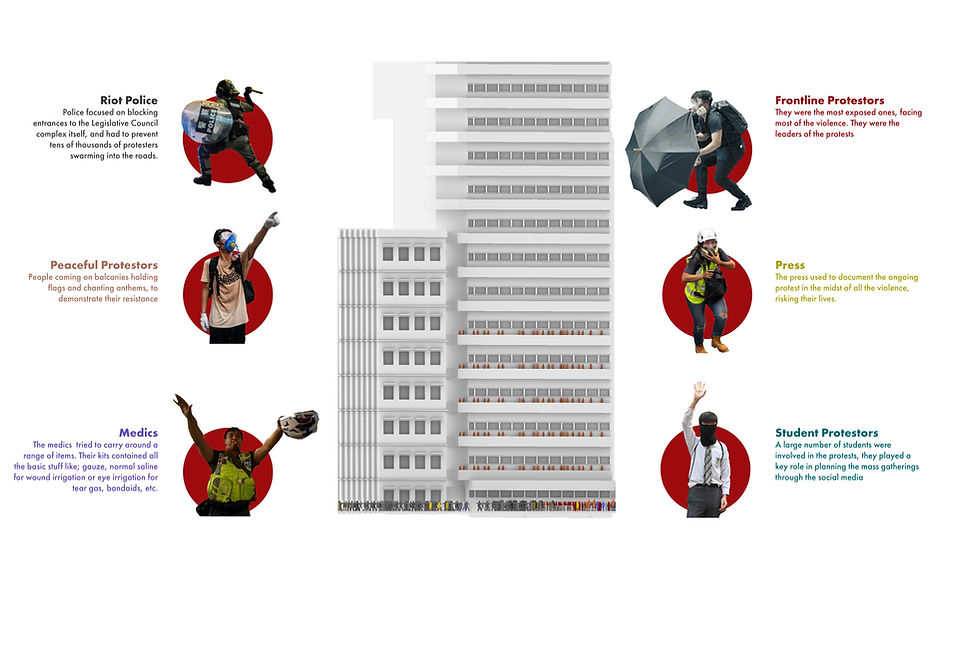
Protestors gather on Harcourt Road to oppose the Extradition Bill, blocking the road to prevent the government officials to enter the Legislative Council. The stop-motion depicts the protest scene where protestors are expressing dissatisfaction with the police's handling of protest and their brutality. The film shows how the protest began with a few frontline protestors against riot police and then gradually the masses coming in to support the frontline protestors. It gradually turns into a mass protest with the media coming in, the medical staff coming to rescue the injured protestors, the peaceful protestors carrying out rallies and shouting out slogans, and finally the students overtaking the protest scene with a overwhelming participation which led to chaos all around, forcing the riot police to step back.

Design proposal
香 港

Hong Kong

Educational Institutions in the area and public gardens are the potential sites for the urban intervention. These pivotal sites will act as a catalyst of regenerative learning spaces around the Kwun Tong and eventually spread in Hong Kong.
"LIBERAL EDUCATION; PREPARING STUDENTS FOR UNDEFINED FUTURES"

"INTEGRATED LEARNING SPACES; INTRODUCING NEW METHODS"

The vision is to introduce learning spaces that interact with the urban space, which will make people re-evaluate their concept of learning and re-shape the current method of controlled environment for learning.
POTENTIAL SITES
KWUN TONG PROMENADE
"RE-DESIGNING URBAN EDGE/THRESHOLD"

Designing Informal education spaces which would act as a threshold between the streets and the learning areas. This would eventually occupy the urban streets and form a connection between the school edge and urbanscapes. By remodeling the existing schools and developing interactive edges, pedestrians can turn into students as well. The intent of this proposal is to not confine the learning spaces into a box classroom and synchronize it with the changing urbanity. The Edge/Boundary would act as a meeting place for students and experts, a true place of transdisciplinary exchange of knowledge, ideas, creativity, and numerous cultural exchange. A unique platform for new forms of urban educational practice would emerge.

"DESIGN PROPOSAL; THE HYBRID WALL"

The existing compound wall of the Kwun Tong Lutheran College is remodeled into a Hybrid-Interactive Wall. It is made to interact with public, or in most cases retract objects, creating a dialogue with public space, introducing play and gathering as possible antidotes. A small street action is created by moving the objects and placing them in different settings and engaging with passers by to create temporary “rooms“ in the street.
"KEY DESIGN ELEMENTS"


"THE INTEGRATED LEARNING; RE-GENERATING URBAN WATERFRONT"


The Kwun Tong Promenade is selected as the main site to design and re-develop the urban-educational spaces.

"DESIGN PROPOSAL; RE-DESIGNED PROMENADE"


"VISUALS; UNDERSTANDING SPACES"


"MODULES; INTERNAL SPACES"


